Sleep / Interactive
How snoring starts: the airway up close
Drag the slider to the right. See step by step what happens at the back of the throat as you go from waking to sleep, and then onto your back.
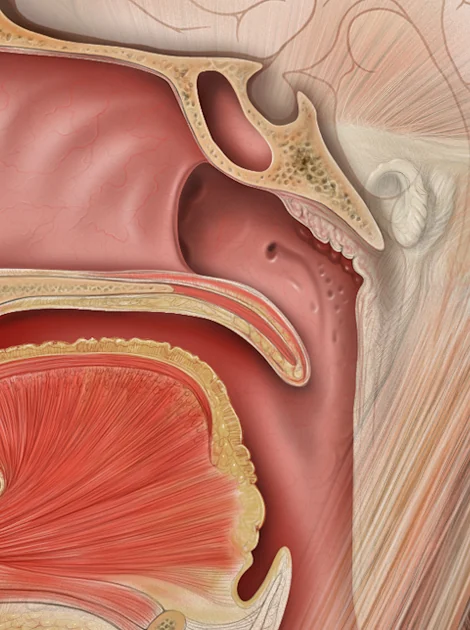
While you are awake, the throat muscles stay firm and keep the airway open. Air comes in through the nose and passes easily through the pharynx.1
Drawing: Patrick J. Lynch, CC BY 2.5; position of the tongue base and soft palate adapted, not to scale. Everyone's airway is different; not all snoring means pauses in breathing.

Why does it narrow during sleep?
The pharynx is a soft tube without bony support. While you are awake, the muscles keep it open. When you fall asleep, the tension in these muscles drops; this happens in healthy people too.1 Someone born with a narrow airway depends more on these muscles. When the muscles relax during sleep, their airway narrows more easily.1
When you lie on your back, gravity joins in too. In most people, pauses in breathing are more frequent and longer when lying on the back.2 The deep, rattling sound of snoring mostly comes from the vibration of the soft palate.3
If you have been told your breathing stops at night, or you are very sleepy during the day, see a doctor. For more, see when to see a doctor.
For expertsmuscle tone, position, acoustics
In obstructive sleep apnea, the pharyngeal airway repeatedly narrows or closes during sleep; while respiratory effort continues, flow falls markedly (hypopnea) or stops (apnea).1 Genioglossus tone falls at sleep onset both in healthy people and in OSA; a person with narrow anatomy compensates for this while awake with increased dilator muscle activity.1
The axis in the drawing is not sleep depth but muscle tone and position. In slow wave sleep, dilator muscle activity does not fall but rises; OSA severity often improves in this stage.1 Most events end with a cortical arousal, but flow can also return without an arousal.1
More than half of patients with OSA can be classified as supine dependent. Proposed mechanisms: unfavourable airway geometry, reduced lung volume, and the dilator muscles failing to compensate enough for collapse.2
Snoring is the vibration of pharyngeal structures. The pitch of palatal snoring consists of a fundamental frequency below 500 Hz and its harmonics; non-palatal snoring is more noise-like, with its energy spread above 500 Hz.3
Sources
- Eckert DJ, Malhotra A. Pathophysiology of adult obstructive sleep apnea. Proceedings of the American Thoracic Society. 2008;5(2):144-153. doi:10.1513/pats.200707-114MG · Review.
- Joosten SA, O'Driscoll DM, Berger PJ, Hamilton GS. Supine position related obstructive sleep apnea in adults: pathogenesis and treatment. Sleep Medicine Reviews. 2014;18(1):7-17. doi:10.1016/j.smrv.2013.01.005 · Review.
- Pevernagie D, Aarts RM, De Meyer M. The acoustics of snoring. Sleep Medicine Reviews. 2010;14(2):131-144. doi:10.1016/j.smrv.2009.06.002 · Review.